High Capacity, Low Cost
Up to 250 SKUs (2-4 X's the Capacity of Coil Machines)
Passive flammable cabinets pass inspection. They do not tell you who walked off with a gallon of MEK at 2 AM. Automated flammable chemical dispensing combines NFPA 30 fire containment with per-user access control and a complete audit trail - every door open tied to a person, every dispense logged, every drum tracked to disposal.
The insurance audit after an incident. When a flammable spill, fire, or regulatory event happens, the first question from the carrier or the fire marshal is who had access to what, when. A paper sign-out sheet with half-legible signatures is not an answer - it is a liability that costs $500K to $5M when a covered loss gets denied.
The reality of creeping chemical cost. Solvent, paint, and specialty-chem line items quietly drift 15 to 30 percent over a budget year with no explanation. Half is honest usage growth; the other half is shrinkage, overstock, waste, and purchases made because nobody could find what was on the shelf. A clipboard cannot tell you which is which.
The compliance finding nobody saw coming. Passive cabinets meet NFPA 30 and OSHA 1910.106 for physical containment - but auditors now expect documentation of access control too. A 2024 OSHA finding pattern: 'no documentation of authorized-personnel access for flammable storage' shows up as a repeat citation at facilities using passive cabinets with paper logs.


The insurance audit after an incident. When a flammable spill, fire, or regulatory event happens, the first question from the carrier or the fire marshal is who had access to what, when. A paper sign-out sheet with half-legible signatures is not an answer - it is a liability that costs $500K to $5M when a covered loss gets denied.
The reality of creeping chemical cost. Solvent, paint, and specialty-chem line items quietly drift 15 to 30 percent over a budget year with no explanation. Half is honest usage growth; the other half is shrinkage, overstock, waste, and purchases made because nobody could find what was on the shelf. A clipboard cannot tell you which is which.
The compliance finding nobody saw coming. Passive cabinets meet NFPA 30 and OSHA 1910.106 for physical containment - but auditors now expect documentation of access control too. A 2024 OSHA finding pattern: 'no documentation of authorized-personnel access for flammable storage' shows up as a repeat citation at facilities using passive cabinets with paper logs.

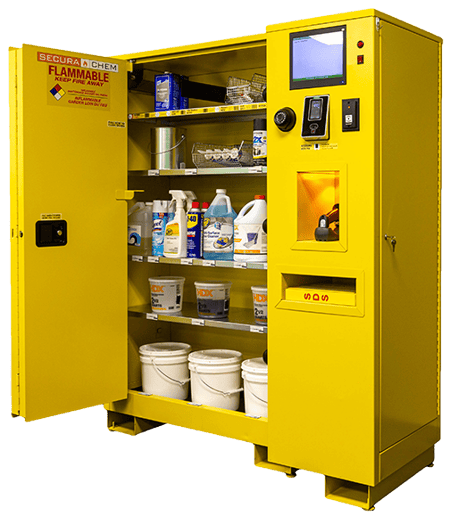
It is the same OSHA- and NFPA-compliant cabinet you already buy - 18-gauge sheet steel, double-walled, self-closing 3-point latch, fusible link rated at 165 F, liquid-tight 2-inch bottom - with four layers added behind the door. Access tied to a person: badge, PIN, mobile app, or facial recognition. Each door open maps to a user ID. Shared keys stop existing. Video-logged transactions: motion-triggered camera records every open, clips tie to user, timestamp, and item.
Threshold and expiration tracking: a paint can comes back two ounces lighter than what was logged out, the system flags it. A drum is past disposal date, EHS gets the alert before the fine. ERP-integrated consumption data: dispensing flows into SecuraChem and SecuraSmart dashboards, then to SAP, Oracle, Plex, or Dynamics. MRO buyers see real consumption by department; finance reconciles against plan; safety reports pull from live data.
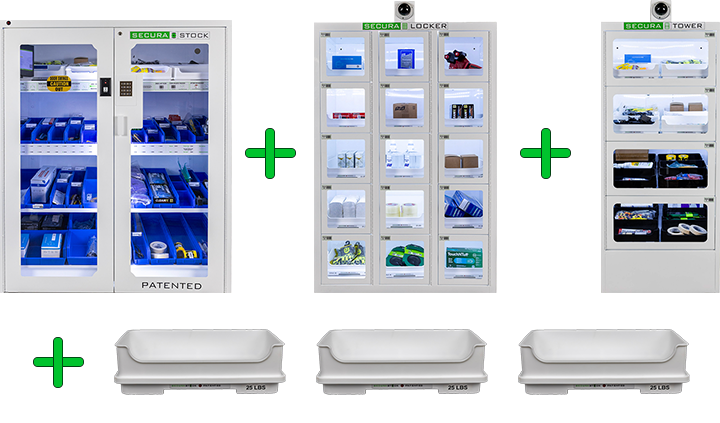
Up to 250 SKUs (2-4 X's the Capacity of Coil Machines)
Four motion-tracking cameras, embedded alarms, and tamper protection.
Magnetized, adjustable shelving supports up to 250 SKUs.
Includes SecuraSmart software with real-time reporting and full inventory control.
We back the system with a guarantee.
Plants that move from passive to automated flammable storage see three consistent results in the first 12 months.
| Metric | Passive cabinet baseline | Automated dispensing | Typical delta |
|---|---|---|---|
| Chemical shrinkage (unaccounted consumption) | 15-30% | 2-5% | ~20 pts recovered |
| OSHA findings per safety audit | 1-3 | 0-1 | ~2/3 reduction |
| Time per month on inventory audit | 8-16 hours | 30 minutes | ~90% labor saved |
| Stockout events per quarter | 6-12 | 1-2 | ~80% reduction |
A $50K annual chemical spend with 20 percent shrinkage is $10K. Recovering 80 percent of that ($8K per year) pays the SecuraChem unit inside 18 months, before counting audit labor savings or compliance-fine avoidance.
What is in the SecuraStock stack for this use case
NFPA 30 - Flammable and Combustible Liquids Code - cabinet construction, ventilation, classification, storage limits | OSHA 29 CFR 1910.106 - Flammable liquids standard - container size, placement, labeling, max allowable quantity per cabinet | IFC 3404 - International Fire Code, storage of flammable and combustible liquids | UL 1275 and FM - Standard for Flammable Liquid Storage Cabinets - UL listing confirms physical test performance, FM Approved for insurance-grade compliance
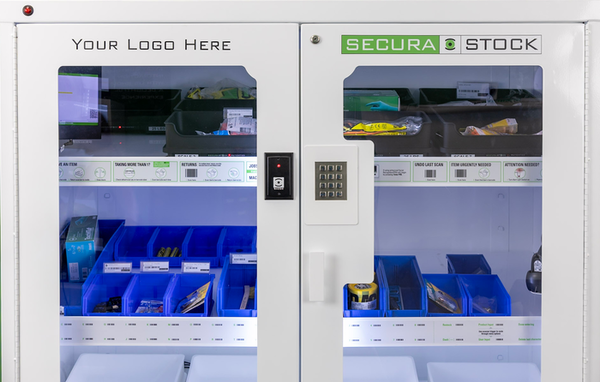
Authenticate: Users scan badge, enter PIN, or use mobile access
Dispense/Retrieve: The system releases or unlocks product
Log Transactions: Everything is recorded (who, when, what)
Monitor & Reorder: Usage data flows into your dashboard, triggering replenishment actions

See SecuraStock in action and discover which solution is right for you

Our team guides you through setup and training so you’re ready from day one

Reduce downtime, cut waste, and keep your team supplied with ease

8 questions buyers ask before scheduling a flammable chemical dispensing demo.
Flammable chemical dispensing is a category of industrial storage that combines fire-rated containment (NFPA 30 and OSHA 1910.106) with user-level access control and transaction logging. The cabinet performs like a standard flammable cabinet from a fire-safety perspective. What is added: authentication at the door, video-logged transactions, threshold alerts, and integration into the facility ERP. The goal is accountability, not just containment.
When the data matters. If your total flammable chemical spend is under roughly $30K a year and shrinkage has never been a concern, a passive cabinet is the right call. Once spend crosses that threshold - or once you have had a compliance finding, a spill investigation, or an insurance audit that asked who took what - the accountability layer pays for itself inside 18 to 24 months on shrinkage recovery alone.
Yes. The cabinet construction is built to NFPA 30 9.5.3 and OSHA 29 CFR 1910.106(d)(3) - 18-gauge double-walled sheet steel, self-closing 3-point latch, 2-inch liquid-tight bottom, fusible link. UL 1275 listed and FM approved. The authentication and logging layers are additions, not substitutions. A SecuraChem unit passes the same fire-code inspection as a passive cabinet of equivalent capacity.
OSHA 1910.106(d)(3) caps a single cabinet at 60 gallons of Class I and Class II flammable liquids combined, or 120 gallons of Class III combustibles. SecuraChem's 69-gallon standard footprint is sized for the lower limit with headroom. For sites that need more, modular cabinet banks - each holding within the 60-gallon cap - are code-compliant when spaced per NFPA 30 9.5.3.
OSHA compliance officers typically ask about training records, cabinet condition, quantity held, labeling, and - if there has been an incident - access history. The digital audit trail answers the access question in seconds instead of rescheduling the inspector while you chase paper logs. We have seen this reduce repeat-citation risk specifically around no-documentation-of-access-control findings.
Yes, with the right specification. SecuraChem offers outdoor-rated variants with NEMA-rated enclosures, weatherproof door seals, and extended-temperature operation. Outdoor placement is common on oilfield and construction sites. Outdoor cabinets still meet NFPA 30 but usually require additional ventilation and ignition-source separation per local fire code.
Out of the box, SecuraChem supports SAP, Oracle EBS, Plex, Microsoft Dynamics, Infor, and a generic REST API for custom systems. Data flows in near-real-time - a dispense event in the plant shows up in the ERP within one to two minutes. Integration is handled during install. Typical setup is one to three days depending on ERP complexity.
The cabinet falls back to local operation. Authentication runs from cached credentials. Transactions queue locally and sync when the network restores. Power-fail fallback includes a mechanical override key for authorized EHS personnel, locked behind a two-factor process that itself is logged. No scenario requires bypassing fire safety - the fusible link and latch remain active under all power states.
SecuraStock covers four use-case pillars across MRO automation - each tied to a different operational pain.
Tool Crib Automation
Vending hardware plus inventory software in one stack
PPE Vending
Per-user dispensing of gloves, glasses, respirators with usage data
MRO Inventory Management
Point-of-use vending that replaces the central storeroom
Industries we serve
Manufacturing, automotive, aerospace, oil and gas, construction
Schedule a live demo and discover how our industrial vending
machines and inventory management solutions can cut costs
and eliminate downtime.