 Jordan Smith
2 min read
Protect Your PPE Supplies From Theft
 Randy Kimberlin : Jul 17, 2026, 7:13:35 AM
Are Your Employees Stealing PPE Supplies? Masks, respirators, gloves and shields are all necessary to protect employees from the...
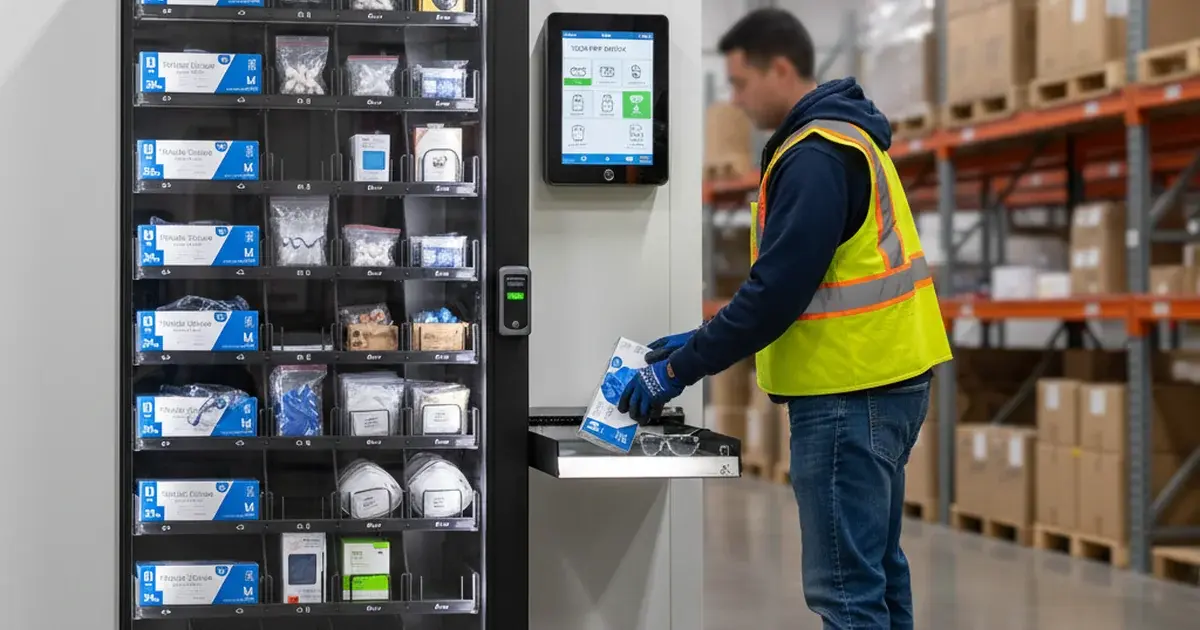
A PPE vending machine looks like a candy machine and replaces something that has barely changed since the 1970s - the supply room with a clipboard. The visible difference is convenience. The structural difference is data. Every glove, every pair of safety glasses, every respirator cartridge that comes out of the machine is tied to a specific employee, a specific shift, and a specific timestamp. That data closes the audit-trail gap that paper PPE sign-out logs cannot defensibly fill.
Personal protective equipment dominates the industrial vending product mix at 41.0 percent revenue share in 2024 (Grand View Research) - which makes sense once you look at the OSHA citation data. In fiscal year 2024 OSHA issued 2,470 citations under Respiratory Protection (1910.134) and 1,814 under Eye and Face Protection (1926.102) (OSHA Top 10 FY2024). Most of those citations land on plants where PPE was technically available but consumption could not be documented. This guide walks through how PPE vending machines work at four levels: the dispensing flow, the SKU mix, the compliance map, and the business case anchored to real injury-cost data.
A PPE vending machine is an industrial vending cabinet configured for safety supplies. The user authenticates, the touchscreen shows only PPE they are authorized for in the right size, the machine dispenses one or more items, and the transaction logs to the inventory system with user, item, size, lot, quantity, and shift. Five categories of PPE - hand, eye, hearing, respiratory, and body protection - typically fit in one cabinet. Per-shift quantity caps prevent over-issuance. Size matrices enforce correct fit by employee. The dispensing log doubles as the OSHA recordkeeping artifact that supports 1910.132, 1910.134, and 1926.102 inspections.
The mechanism mirrors general industrial vending but adds two PPE-specific enforcement layers (size and quantity caps) at the selection step.
Step 1 - Authenticate. The worker scans a badge, enters a PIN, taps a mobile-app QR code, or presents a face to the camera. The system pulls up that worker's PPE matrix - what they are cleared for, what sizes they wear, and what quantities remain in their shift allocation. Forklift operators see hi-vis vests and steel toes; lab technicians see chemical-resistant gloves; office staff see nothing if they have not been added to the matrix.
Step 2 - Select. The touchscreen displays only the items this worker is authorized for, in the sizes they need. No scrolling through 200 items they will never use. If the worker has hit their shift cap (typically one pair of safety glasses per quarter, two pairs of gloves per shift, one respirator cartridge per scheduled change), the system blocks the selection and routes to a supervisor for override.
Step 3 - Dispense. Door opens to the right bin, or a coil rotates to drop a single pair of gloves, or a column pushes out an earplug pack. A camera typically records the transaction. End-to-end dispensing time is 10-15 seconds.
Step 4 - Report. The transaction posts to the inventory system within 1-2 minutes. Nightly rollups feed consumption data into safety management systems (VelocityEHS, Cority, SAP EHS) and ERP cost-allocation modules. EHS managers see per-user, per-shift, per-department PPE compliance by morning.
The full workflow takes less time than walking to the supply room. The data layer is what closes the compliance gap.
A single 250-SKU vending cabinet typically covers all five OSHA-recognized PPE categories with room left for plant-specific specialty items.
Hand protection. Nitrile gloves (multiple gauges and sizes), cut-resistant gloves (ANSI cut levels A1 through A9), chemical-resistant gloves (rated by chemical class), heat-resistant gloves, leather work gloves. Dispense pattern: per pair from a coil or per box from a locker. The most-vended PPE category at every plant we install.
Eye protection. Safety glasses (Z87.1 stamped), goggles (vented and non-vented), face shields, prescription-insert frames for workers with corrective lenses. Dispense pattern: single units from a locker bin.
Hearing protection. Foam earplugs (single-use, NRR 28-33), reusable earplugs, banded earplugs, earmuffs (over-the-head and cap-mounted). Dispense pattern: column dispensers for disposable plugs, locker bins for reusables and muffs.
Respiratory protection. N95 disposable masks, half-face respirators, full-face respirators, P100 cartridges (and the chemical-specific cartridges - organic vapor, acid gas, multi-gas). Fit-test data lives in the user profile so the system blocks dispense of a respirator the worker is not fit-tested for, per OSHA 29 CFR 1910.134.
Body protection. Hi-vis vests, FR shirts and pants, Tyvek suits, lab coats, aprons, sleeves. Dispense pattern: shift-start retrieval, often paired with shift-end return for reusable items.
For plants with specialized exposures, climate-controlled or hazmat-rated configurations add a sixth category - chemical PPE that requires temperature-stable storage or proximity to the flammable chemical dispensing area.
The single feature that separates PPE vending from generic supply-room access is enforcement at dispense time.
Sizing matrices. Each worker's PPE profile records glove size, respirator fit-tested model, vest size, and footwear size. The machine refuses to dispense a size that does not match the profile unless a supervisor overrides. New hires complete sizing in the first week; the matrix updates through HR integration.
Allergen flags. Latex-free, nitrile-only, or chemical-class restrictions live on the worker profile. The system never offers latex gloves to a worker flagged latex-allergic. This is the kind of enforcement that paper sign-out sheets cannot do because the supply-room clerk does not know everyone's allergy list.
Quantity caps. "One pair of safety glasses per quarter" is a typical cap. "Two pairs of nitrile gloves per shift" is a typical cap. The third pair triggers a supervisor alert - the worker is either burning through gloves on a contaminated task that needs investigation, or they are taking gloves home. Either is worth knowing.
Replacement intervals. Safety glasses are authorized for replacement at six-month intervals; respirator cartridges have a service-hour budget per their NIOSH approval; FR clothing has wear-out cycles. The system tracks per-user entitlement and blocks early replacements unless a supervisor overrides on documented damage.
The PPE vending log is not just inventory data. It is the audit-trail record that OSHA inspectors increasingly expect to see during enforcement visits.
29 CFR 1910.132 (General PPE). Requires hazard assessment, PPE training records, and verification that PPE is provided where required. The vending log shows who was issued what when - the proof that PPE was provided.
29 CFR 1910.133 (Eye and Face Protection). Z87.1 stamped equipment, proper for the task. The dispensing log shows which model was issued to which worker. Combined with hazard-assessment records, the log closes the documentation loop.
29 CFR 1910.134 (Respiratory Protection). Fit-testing records per worker per respirator model. The vending system enforces that no respirator is dispensed unless the worker is fit-tested for that exact model and cartridge type. Fit-test dates roll into the user profile.
29 CFR 1910.138 (Hand Protection). Hazard-based glove selection. The role-based PPE matrix in the vending system enforces correct cut level and chemical class per worker's task assignment.
29 CFR 1926.102 (Construction Eye and Face Protection). Issued 1,814 citations in FY2024 as the #9 most-cited standard (OSHA). On construction sites, vending units on service trucks (truck-mounted enclosures like SecuraPort) provide the same audit trail as plant-floor units.
The recordkeeping requirement does not specify what format the records take. OSHA accepts paper logs, spreadsheets, or digital audit trails. The digital trail is the one that holds up under scrutiny.
Two procurement paths exist. The choice has long-term implications most buyers do not see in the first quote.
Service-bundled programs. National PPE service providers and uniform-service contracts bundle vending hardware into a monthly contract that includes restocking, supply, and hardware support. The trade-off: PPE catalog is restricted to the service provider's supply chain, consumption data lives in the provider's system, and switching providers means swapping hardware. Monthly cost is predictable but rolls forever.
Standalone vending. You buy or lease the machine and software directly, pick your own PPE suppliers, own your own consumption data, and integrate with whichever ERP or EHS platform you already run. Higher upfront capital, lower long-term run rate, full data portability. SecuraStock follows the standalone model - one-time hardware acquisition plus a software subscription, no PPE supply lock-in.
The right choice depends on your scale and procurement preference. Single-site operations with simple PPE needs often pick service-bundled. Multi-site operations and any plant with strong supplier-management discipline usually pick standalone.
PPE vending economics are different from MRO vending because PPE is dominated by shrinkage costs, not labor costs.
| Cost line | Without vending (250-worker plant) | With vending |
|---|---|---|
| Annual PPE spend (~$400/worker) | ~$100,000 | ~$100,000 (no change) |
| Shrinkage / loss rate | 30-50% typical | 5-15% typical |
| Shrinkage $ recovered | - | ~$25K-$35K/yr |
| Supply-room labor (0.5 FTE) | ~$35,000 | ~$3K (refill only) |
| Compliance audit prep (per quarter) | 8-16 hours | 30 minutes |
| Expedite shipping on PPE stockouts | $3K-$8K | near zero |
| Hardware + software 3-year TCO | $0 | ~$65,000 |
Net Year 1 impact at this scale is typically $40K-$60K positive after hardware costs. The ratios hold reasonably well from 100-worker plants to 1,000-worker plants - bigger plants get more shrinkage recovery but also need more units.
The injury-cost data is what makes the safety case quantitative. The 10 most serious workplace injury categories cost US businesses $47.93 billion annually (Liberty Mutual 2024 Workplace Safety Index). US employers pay more than $1 billion per week in direct workers' compensation costs for non-fatal disabling injuries. PPE compliance is one of the variables that moves both numbers downward.
US private industry recorded 2.5 million nonfatal workplace injuries and illnesses in 2024 at an incidence rate of 2.3 per 100 FTEs - the lowest rate since the survey began in 2003 (BLS USDL-26-0101). NIOSH's foundational guidance has not changed: PPE should be placed at the point of use to promote compliance (NIOSH PPE Information). Vending at the workstation is the operational expression of that guidance.
For the full deployment pattern by plant type, see our companion piece on PPE vending use cases.
How do PPE vending machines work? A worker authenticates at the machine via badge, PIN, mobile app, or facial recognition. The touchscreen shows only PPE the worker is authorized for in the correct size. The machine dispenses the requested item from a coil, locker, or column dispenser. The transaction logs to the inventory system with user, item, size, quantity, lot, and timestamp. Nightly rollups feed safety management systems and ERP cost-allocation modules.
What types of PPE can a vending machine dispense? Hand protection (nitrile, cut-resistant, chemical-resistant gloves), eye protection (Z87.1 glasses, goggles, face shields), hearing protection (foam plugs, banded plugs, earmuffs), respiratory protection (N95, half-face and full-face respirators, cartridges), body protection (hi-vis vests, FR shirts, Tyvek suits, lab coats). Specialty configurations cover hazmat-rated, climate-controlled, and high-value reusable PPE.
Do PPE vending machines help with OSHA compliance? Yes. The dispensing log is the audit trail that supports OSHA 29 CFR 1910.132 (general PPE provision), 1910.133 (eye protection), 1910.134 (respiratory protection), 1910.138 (hand protection), and 1926.102 (construction eye protection). The log shows per-worker, per-shift PPE issuance with timestamps - the documentation paper logs cannot defensibly produce.
How much do PPE vending machines cost? Hardware acquisition runs $8,000-$15,000 per cabinet, software subscription $50-$200 per machine per month, install $500-$2,000 per site. For a 250-worker plant, 3-year total cost typically lands $45K-$80K. Net Year 1 impact (shrinkage recovery + labor savings) typically runs $40K-$60K positive after hardware costs.
Can a PPE vending machine track who took what? Yes - this is the core function. Every dispense logs to the inventory system with user ID (badge or biometric), item ID, size, quantity, lot number, timestamp, and shift. Reports can be filtered by user, department, shift, item, or date range. The log doubles as the OSHA recordkeeping artifact.
How are PPE vending machines restocked? A designated stocker (in-house EHS lead or external distributor) refills the machine on a defined schedule, typically weekly or biweekly. Restocking events are logged separately from dispenses. The inventory system shows which SKUs are approaching reorder threshold so restocking can be batched efficiently. Restocking labor drops 60-80 percent vs traditional supply rooms.
Are PPE vending machines worth it for small facilities? Below 100 workers the financial case weakens because shrinkage in absolute dollars is small. For regulated industries (aerospace, automotive, FDA-regulated manufacturing) the compliance value justifies vending even at small scale. For a single-site operation with stable PPE needs and a small headcount, a service-bundled program is often the simpler answer.
What is the difference between a PPE vending machine and a PPE locker? A vending machine dispenses one unit at a time on demand with per-user tracking. A PPE locker is a locked compartment that holds one user's assigned PPE between shifts - typically reusable items like respirators, hard hats, or FR clothing. Most plants deploy both: vending for consumables, lockers for assigned reusables. The same inventory dashboard tracks both.
2 min read
Randy Kimberlin : Jul 17, 2026, 7:13:35 AM
Are Your Employees Stealing PPE Supplies? Masks, respirators, gloves and shields are all necessary to protect employees from the...
8 min read
 Noah Twigg : Jul 13, 2026, 4:13:14 PM
How to Reduce MRO Stockouts by 80% - A Plant Manager's Playbook A stockout is not an inventory failure. It is a margin event. The 6-cent gasket...
3 min read
Randy Kimberlin : Jul 17, 2026, 7:31:41 AM
Aerosol cans are a convenient way to store products, but they can be dangerous if not handled properly. In this blog post, we’ll discuss the...